


Portuguese Justice Auctions 33 Lots of Gold Valued at Half a Million Euros

Some auctions are just commercial transactions. And then there are auctions that tell stories — stories of judicial investigations, of seized assets, of cases that drag on for years in the courts. The auction of 33 gold lots that the Portuguese State put up for sale in September 2026 is one of those cases.
We're talking about half a million euros in gold bars, jewellery and other precious objects, all of them originating from legal proceedings. Assets that were seized, recovered or declared forfeited to the State. And which are now looking for new owners.
The operation was promoted by the Asset Management Office (GAB), the body that forms part of the Institute for Financial Management and Justice Equipment (IGFEJ) of the Ministry of Justice, and the bids took place on the E-leilões platform until 7 October 2026.
But what's behind this sale? Who are the real protagonists of this story? And why is this auction just the tip of the iceberg of a far more complex system?
What was auctioned
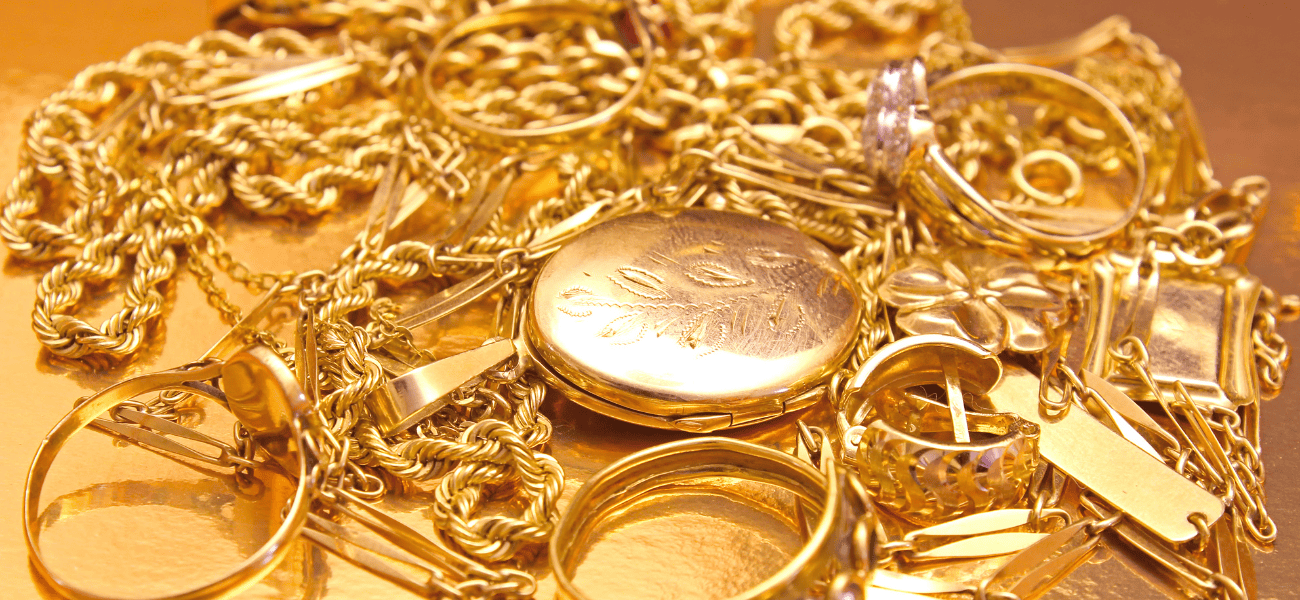
The 33 lots included an impressive variety of assets. From gold bars with certified purity to jewellery from different eras and styles, as well as objects in precious metals of various kinds.
Individual lot valuations ranged between 6,000 and 25,000 euros, reflecting the diversity and value of the assets available.
Among the examples that became publicly known through the E-leilões platform are pieces such as a 19.2kt gold bracelet set with garnets, with a "dragon" hallmark dated 1938-84 and a weight of 52.2 grams. Or a lot consisting of a 999.9‰ gold sheet, with a total gross weight of approximately 198.7 grams, accompanied by an assay report issued by the INCM Assay Office.
There were also more unusual lots, such as 24 rings in the process of being made, in 800‰ white gold, with Portuguese marks in force.
All these assets had been previously appraised by official experts, and the available documentation included assay reports, purity certifications and INCM hallmarks — ensuring transparency and rigour throughout the process.
Who the GAB is and what it does
To understand this auction, you need to understand the body that promotes it. The Asset Management Office is not an ordinary auction house. It is a public service, part of the Ministry of Justice, with a specific mission: to administer, conserve and manage assets seized, recovered or declared forfeited to the State.
When an object is seized in the context of a criminal investigation — whether it's a gold bar, a car, a property or a work of art — it can remain for years at the disposal of the case. Until there is a final court decision, someone has to ensure that this patrimony is conserved, managed and, wherever possible, does not lose value.
That's where the GAB comes in. The office can be responsible for:
- Money, gold and other precious metals
- Jewellery and valuable objects
- Motor vehicles
- Vessels and aircraft
- Real estate
- Shareholdings in companies
When an asset is definitively forfeited to the State, the GAB can promote its sale. But not only that. Depending on the case, its allocation to a public entity or another destination provided for by law may also be proposed or determined.
The numbers that show the scale of the system
The September 2026 auction is not an isolated case. It is part of a system that moves millions of euros every year.
In 2021 alone, 836 assets seized or forfeited to the State were handed over to the GAB, following 352 requests from judicial authorities and the Asset Recovery Office. The value of the assets exceeded 23 million euros.
That same year, the office auctioned assets valued at around 1.5 million euros. The list included an aircraft, several vessels, gold and other precious metals, motorcycles and cars.
Activity continued in the following years. In 2024, 130 auctions of seized, recovered or forfeited assets were held, with a valuation value exceeding 12.4 million euros. By 23 December that year, sales had raised 994,700 euros.
In 2023, for example, two shareholdings in fishing-related companies were put up for sale, along with a fishing vessel valued at 150,000 euros and a sailing yacht valued at 100,000 euros.
And the numbers keep growing. According to data released by IGFEJ, the State currently holds:
- 2,254 vehicles
- 1,288 properties
- 71 vessels
- 1,749 objects in gold and precious materials
- 356 works of art
- 1,743 seized bank accounts
In addition, there are 779 ongoing cases in which the GAB's intervention has been requested, but which are awaiting a judicial decision.
The destination isn't always auction
Sale is one of the solutions, but it is not necessarily the first or the only one. In certain situations, the law allows an asset to be sold before a final decision exists in the case.
The so-called early sale can be used, for example, when there is a risk of the asset deteriorating, losing value or generating high conservation costs. The money obtained from the sale is then linked to the case and awaits the court's final decision on its destination.
One of the most high-profile cases was a luxury villa in Quinta da Marinha, sold by the GAB in 2026 for around 11 million euros. The property's valuation was over eight million. As this was an early sale authorised by the court, the money remains deposited at the disposal of the case until a final decision is reached.
There are also cases in which assets are allocated to public entities. Since 2011, 126 motor vehicles have been allocated to various public bodies and entities.
What happens to assets nobody buys
Not all assets find a buyer at the first auction. According to data from the E-leilões platform, on average only 42% of sales take place at the first auction of the asset. Most return to auction, often at reduced values.
When there is insufficient demand, the sale moves to private negotiation. As Mara Fernandes, president of the Professional Council of the College of Enforcement Agents, explains, "the asset will always be sold", but "the value may have to be reduced, in agreement with the parties and with the appropriate request to the judge".
This is an important mechanism to ensure that assets do not remain indefinitely in the State's possession, generating conservation and maintenance costs.
The E-leilões platform: ten years of history
The E-leilões platform was created in 2016, initially to sell pledged assets. Today, it also includes assets seized, recovered or declared forfeited to the State in criminal proceedings, as well as assets resulting from insolvencies.
In ten years of operation, up to July 2026, the platform sold more than 8 billion euros in assets, across more than 105,000 auctions, which received 1.41 million bids.
Real estate is the most bid-on category — from buildings to apartments, houses or land. In 10 years, sales in this category reached 7.8 billion euros, with more than a million bids.
In recent years, rights have become the second most sought-after category, with parts or shares of inheritances already sold for a total value of 153.7 million euros.
Vehicles now occupy third place, followed by movable assets, which may include machinery, gold and silver pieces or works of art.
How assets are appraised
One of the most important aspects of this whole process is the appraisal of assets. In the case of gold and precious metals, appraisal is carried out by official experts, using entities of recognised competence.
According to the GAB's own documents, the Portuguese Mint and Official Printing Office (INCM) is the entity responsible for appraising gold and precious metals. This is the same entity that certifies jewellery and precious metals in Portugal, guaranteeing quality and authenticity standards.
In the specific case of the gold lots auctioned in September 2026, the listings included detailed information on fineness, hallmarks, weights and dates, all determined by official appraisal experts.
Interested parties could also consult assay reports, such as the lot with the 999.9‰ gold sheet, which included an X-ray fluorescence report issued by the INCM Assay Office.

How to take part in a GAB auction
If you're interested in taking part in a future Portuguese State auction, here is the essential information.
To take part, you need to:
- Register on the E-leilões platform (www.e-leiloes.pt)
- Validate your identity, providing a tax number and an address in Portugal
- Check the sale listings available on the GAB page on the IGFEJ website
- Follow the bidding and, where possible, schedule visits to inspect the assets
Assets are sold in the physical and legal condition in which they are found. This means it is the bidder's responsibility to verify the condition of the assets before bidding. Failure to verify is not grounds for annulment of the sale procedure.
After the auction closes, the winner is notified and typically has 15 working days to make payment.
Why this matters
Beyond the obvious financial interest — after all, we're talking about gold at potentially below-market prices — this system has an importance that goes beyond monetary value.
Firstly, it is a way of recovering assets for the State. The money obtained from these sales can be used to fund public services, to compensate victims of crime or for other purposes determined by law.
Secondly, it is a mechanism of justice. When an asset is declared forfeited to the State, it is because the court has determined that its origin was unlawful or that there was no identifiable legitimate owner. The public sale ensures that this asset returns to the legal circuit, generating value for society.
Thirdly, it is a matter of transparency. All processes are public, documented and subject to scrutiny. Any citizen can consult the listings, take part in the bidding and follow the results.
What this means for the gold market
For those who buy and sell gold, this type of auction represents a unique opportunity. On the one hand, there is the possibility of acquiring gold at competitive prices. On the other, there is the guarantee that the assets have been appraised by official experts and that all documentation is in order.
However, it is important to bear in mind that these auctions are not for amateurs. You need to:
- Know the market and be able to assess the real value of the assets
- Have the financial capacity to place competitive bids
- Be prepared to deal with the bureaucracy inherent in these processes
- Understand that assets are sold in the condition in which they are found
For those with experience in the gold market, these auctions can be an interesting source of unique pieces — from vintage jewellery to gold bars with purity certification.
And after the auction?
The September 2026 auction has already ended, but the system continues to operate. The GAB holds auctions regularly throughout the year, and there are always new lots available.
Those who are interested can follow upcoming initiatives through the IGFEJ page, where asset sale listings are published. The E-leilões platform is always active, with hundreds of lots available across different categories.
And for those with no interest in taking part, there remains the curiosity of knowing that, somewhere, there is a Portuguese State vault full of gold awaiting the next auction. Stories of judicial investigations, of seized assets, of cases that drag on for years. And, at the end of it all, a new opportunity for these objects to shine again.
Team note: At Lusijoia, we follow the gold market in all its forms with interest. If you have gold you would like to sell or have appraised, our team of specialists — including official Mint appraisers — is available to help. Transparency and rigour are our priority. Visit us in store or online.
#Lusijoia #Auctions #Gold #GAB #MinistryOfJustice #SeizedAssets #GoldInvestment #E-Leiloes #Justice #Transparency
Related posts

Theft with a Happy Ending: GNR recovers gold jewelry worth €80,000

A Gold Bar Hidden in Lapland: Treasure Hunt
MUDE. All the beauty of the world in 502 contemporary jewels.

Portojóia 2026: "Luxury Redefined" and the future of Portuguese jewelry

New post

Margarida Corceiro's Shine at the 2026 Venice International Film Festival

Essential Vintage Jewelry: A guide for collectors (and those who want to start)

How to Match Eyeglass Frames with Your Jewelry (The Guide Your Style Was Missing)

The Importance of Choosing the Right Lenses for Sunglasses, Along with Jewelry