

MUDE. All the beauty of the world in 502 contemporary jewels.
There is a bracelet that looks like it's made of rubber. Simple. Almost unassuming. But when you hold it in your hands and feel the weight, you discover what's inside: solid gold. It's a creation by German artist Otto Künzli, and it sums up everything you'll find at MUDE this autumn. What seems simple hides unexpected depth. What seems ordinary reveals a beauty that demands our recognition.
From 25 September 2026, the Museum of Design in Lisbon opens its doors to two exhibitions that place contemporary jewellery at the centre of the city. In total, there are 502 pieces inviting us to rethink what a jewel is — and, by extension, what value, beauty and the very act of creating mean.
What you'll find at MUDE
The museum's second floor, on Rua Augusta, hosts two complementary exhibitions that are part of the official programme of the 3rd Lisbon Contemporary Jewellery Biennial.
The first is the Tereza Seabra Collection, an extraordinary donation to the Municipality of Lisbon that brings together 346 works by 196 artists — 84 Portuguese and 112 international. Tereza Seabra, an artist, gallerist and teacher now 82 years old, spent over four decades assembling these pieces. It is not an anthology of her work, but rather a mirror of her vision as a collector and of the network of connections she built with different generations of creators.
The second is "Coexistences – Jewellery and the Beauty of the World", the Biennial's core exhibition, curated by Marta Costa Reis and Patrícia Domingues. Here, the theme is clear: how can we coexist more fairly, empathically and interconnectedly with the other worlds around us — the mineral, the microbial, the fungal, the vegetal, the animal, the spiritual and the digital?
A bracelet that hides gold (and a lesson about value)
The story of Otto Künzli's bracelet is the best starting point to understand what distinguishes contemporary jewellery. Outside, rubber. Inside, gold. MUDE's director, Bárbara Coutinho, explains what's at stake: "It is not the value of the material that matters here, it is the value of the concept, the idea, the challenge of reflection proposed."
This inversion — the precious hidden in the ordinary — runs through the entire exhibition. You'll find creations made from onion skins (in a giant collar that is as visually striking as it is ephemeral), pill blister packs, egg membrane, dehydrated orange, human hair, sand from an artificial beach or old mobile phone carcasses.
Materials we normally associate with rubbish or waste become, here, vehicles for reflection on the body, society and culture. As Bárbara Coutinho says, "we can find beauty in the most ordinary things, which require our recognition."
Tereza Seabra: the woman who collected half a century of jewellery
Tereza Seabra was born in 1944. At 82, she remains active and supports new jewellers. Her collection is a visual map of a life dedicated to contemporary jewellery — as a creator, teacher, gallerist and now donor.
The oldest pieces date back to 1968, although the exhibition is not organised chronologically. What unites this collection is the vision of a collector who was never swayed by material value, but always by conceptual value.
The incorporation of this collection into MUDE is no accident. Since 2019, the museum has been building a contemporary jewellery nucleus in partnership with PIN – Portuguese Association for Contemporary Jewellery. Tereza Seabra's donation now gives this project a new scale, consolidating Lisbon as an international reference point in this field.
"Coexistences": the exhibition that asks how we inhabit the world
If the Tereza Seabra Collection looks to the past — to six decades of creation —, "Coexistences" looks to the future. And it does so with urgency.
The exhibition starts from a central question: how can we coexist more fairly and interconnectedly? At a time when artificial intelligence is becoming predominant, the curators invite us to question the other intelligences that exist in the world and with which we rarely engage.
"What does a stone, a stick, a pinecone, animals tell us? We have difficulty communicating", reflects Marta Costa Reis. Jewellery, with its ability to operate on the border between body and world, between matter and symbol, is the perfect vehicle for this exploration.
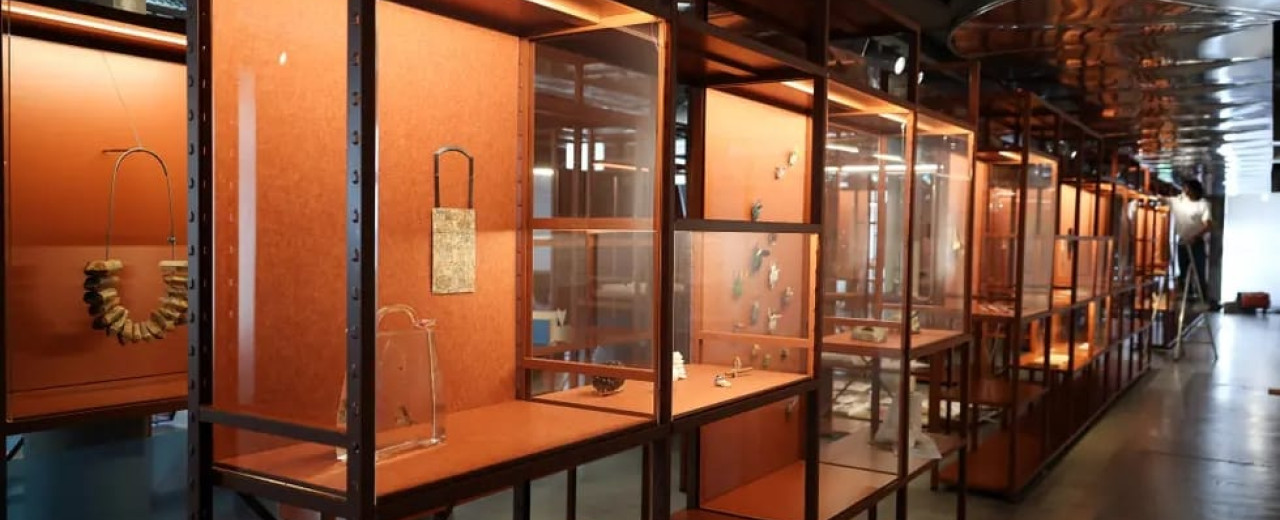
The exhibition design, by Miguel Vieira Baptista, recreates a contemporary cabinet of curiosities, with terracotta tones and a visual density that invites classification and discovery. The jewels seem to float on transparent acrylic and polyurethane acetate structures, in a design that dematerialises the support and places the pieces at the centre of attention.
What makes this exhibition different from anything you've seen
1. Jewellery is not an accessory
The first thing you need to forget is the idea that a jewel is just an adornment. Here, each piece is a conceptual work of art that questions the body, society and ecology. The jewel is an object that has always operated on the border — between body and world, between matter and symbol, between presence and memory.
2. Value is not in the material
Gold, silver, diamonds? All of that exists, of course. But what matters here is the concept. A collar made of onion skin can be as valuable — conceptually — as a diamond necklace. The question that remains is: why do we value what we value?
3. Materials that tell stories
The artists represented in this exhibition use materials that speak. Pill blister packs speak of health and illness. Egg membrane speaks of fragility and protection. Mobile phone carcasses speak of technology, obsolescence and memory. Each material is a choice, and each choice is a statement.
4. A biennial that goes beyond the museum
MUDE is the epicentre, but the 3rd Contemporary Jewellery Biennial extends across several spaces in Lisbon, including the Convento dos Cardaes and Ar.Co – Centre for Art and Visual Communication. There are more than 25 exhibitions and parallel initiatives, plus masterclasses, conferences and an international symposium on 25 and 26 September.
What not to miss
The masterclasses
Between 19 and 23 September, Ar.Co hosts masterclasses with some of the most important names in international contemporary jewellery, such as Ted Noten and Sofia Björkman. A rare opportunity to learn from those shaping the future of the field.
The international colloquium
On 25 and 26 September, MUDE organises a colloquium bringing together artists, researchers and thinkers from different disciplines. The programme is organised into three sessions: "Sentient Materiality", "Otherness" and "Technopoetry". Each session is an invitation to rethink the relationships that constitute us and to imagine more attentive and fair ways of inhabiting the world.
The "Jewellery Room"
Between 25 and 27 September, the Convento dos Cardaes hosts the "Jewellery Room", a space dedicated to presenting contemporary jewellery pieces. It's an opportunity to see — and perhaps acquire — works by emerging and established artists.
The "What Makes Us Blind" exhibition
Also at the Convento dos Cardaes, the exhibition "What Makes Us Blind" opens on 23 September, exploring the limits of perception and vision.
Practical information
| Detail | Information |
|---|---|
| Location | MUDE – Museum of Design, Rua Augusta, 24, Lisbon |
| Dates | 25 September 2026 to 31 January 2027 |
| Opening hours | Tuesday to Sunday, 10am–7pm (Fridays and Saturdays until 9pm) |
| Ticket | €11 (discounts for students, young people 13–25 and seniors +65) |
| Coexistences curatorship | Marta Costa Reis and Patrícia Domingues |
| Tereza Seabra Collection curatorship | Tereza Seabra, Manuel Castro Caldas and Marta Costa Reis |
| Exhibition design | Miguel Vieira Baptista (Coexistences) and Fernando Brízio (Tereza Seabra Collection) |
Why this matters (even if you're not in the field)
You might be thinking: "I don't know anything about contemporary jewellery. This is for specialists." Not at all.
This exhibition is not about goldsmithing techniques or precious metals. It's about how we look at the world. About how we value things. About how we relate to materials, to other beings, to the planet.
Contemporary jewellery is perhaps the most intimate art form that exists. It's on the body. It touches the skin. It accompanies us in our movements. And, for that reason, it's also the most political art form — because it questions what we choose to carry with us and why.
When you see a collar made of onion skin, or a rubber bracelet hiding gold, you're being invited to think: what do I value? Why do I value it? And what does that say about me?
Conclusion: 502 reasons to go to MUDE
From 25 September, MUDE will host one of the most extensive presentations of contemporary jewellery ever staged in Portugal. There are 502 pieces. 502 stories. 502 invitations to reflection.
If you like jewellery, you'll love it. If you like art, you'll love it. If you like thinking about the world we live in, you'll love it even more.
And, by the way, if you never thought an onion skin could be beautiful, prepare to change your mind.
"And you, have you visited MUDE? Will you take advantage of the Biennial to discover contemporary jewellery? Tell us in the comments — the conversation continues." ?
#Lusijoia #MUDE #ContemporaryJewellery #JewelleryBiennial #Coexistences #TerezaSeabra #Lisbon
Team note: Contemporary jewellery is a fascinating universe that challenges us to rethink what a jewel is. At Lusijoia, we value the tradition of Portuguese goldsmithing, but we also recognise the importance of looking to the future. This exhibition is a unique opportunity to see how other artists are reinventing jewellery — and, who knows, to inspire us to continue creating pieces that tell stories.
Related posts

Portuguese Justice Auctions 33 Lots of Gold Valued at Half a Million Euros
Theft with a Happy Ending: GNR recovers gold jewelry worth €80,000

A Gold Bar Hidden in Lapland: Treasure Hunt

Portojóia 2026: "Luxury Redefined" and the future of Portuguese jewelry

New post
Margarida Corceiro's Shine at the 2026 Venice International Film Festival
Essential Vintage Jewelry: A guide for collectors (and those who want to start)
How to Match Eyeglass Frames with Your Jewelry (The Guide Your Style Was Missing)
The Importance of Choosing the Right Lenses for Sunglasses, Along with Jewelry