

Mixing Metals: The Trend That’s Here to Stay for Fall/Winter 2026

For decades, the rule was clear and rarely questioned: choose your metal and stay faithful to it. Yellow gold, white gold, or rose gold — but never all three at once. Traditional jewellery treated the mixing of tones as a style error, a lack of coherence that betrayed a lack of taste. That time is over.
In autumn/winter 2026, mixed metal — the deliberate mixing of different gold tones in the same composition — has gone from a marginal boldness to one of the season's most consistent trends. The runways confirmed it, high jewellery brands adapted it and, more importantly, the everyday consumer found in it a long-desired freedom: the freedom to wear what they already have, without asking permission from conventions.
For those who follow the Portuguese jewellery market, this is a particularly relevant turning point. Portugal has a deeply rooted goldsmithing tradition, but also a growing openness to contemporary languages. The mixed metal trend does not require new pieces: it requires, above all, a new way of looking at those that already exist in our jewellery box.
The end of the rule that no one respected anymore
The truth is that the "one metal per look" rule had already been undermined for several seasons. Stacked rings, layered necklaces, mismatched earrings — all of this was preparing the ground for the mixing of tones to stop seeming accidental and become intentional. What has changed now is the qualitative leap: it is no longer just about combining separate pieces of different tones, but about finding jewellery that is already born with that mix built into the design itself.
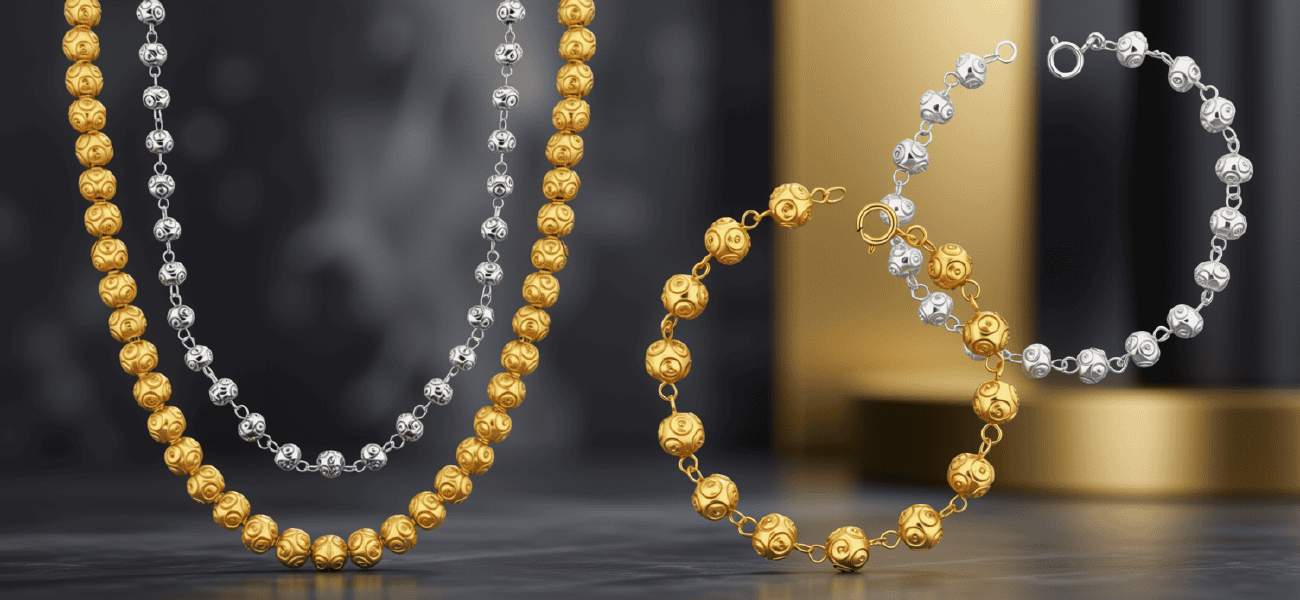
The My Dior collection, designed by Victoire de Castellane, is perhaps the most cited example of this new approach. The maison's cannage motif becomes a gold mesh where the three tones coexist, sometimes in the same piece, sometimes in versions that can be layered and recombined. The message is clear: jewellery no longer demands absolute chromatic coherence and has come to value personal, asymmetrical, almost spontaneous composition.
On the streets of fashion weeks — from Copenhagen to London — the trend became visible not only on the runways, but in the looks of those attending the shows. Wide silver bracelets next to yellow gold rings, rose gold necklaces combined with white gold pieces: what would once have been considered an incongruity came to be read as a statement of personal style. The maxim "fewer rules, more freedom" applies here with precision.
Why this trend makes sense now
There is a practical reason that explains the popularity of mixed metal, and it is particularly relevant for the Portuguese consumer: most people do not have a jewellery collection built in a strictly monochromatic way. We inherit family pieces in yellow gold, buy wedding rings in white gold, receive earrings in rose gold. For years, these pieces lived in separate compartments, as if they belonged to incompatible worlds.
The autumn/winter 2026 trend comes precisely to legitimise the opposite: that these pieces can — and should — be worn together. The result is not a visual salad, but a composition with depth. The warmth of yellow gold, the cold shine of white gold, and the softness of rose gold create layers of contrast that uniformity can never reproduce.
Furthermore, there is an undeniable economic factor. At a time when the price of gold is reaching high values, the possibility of refreshing your look without buying new pieces is a powerful argument. Mixed metal doesn't ask for an investment: it asks for a rearrangement. It asks you to open the jewellery box and try combinations that once seemed forbidden.
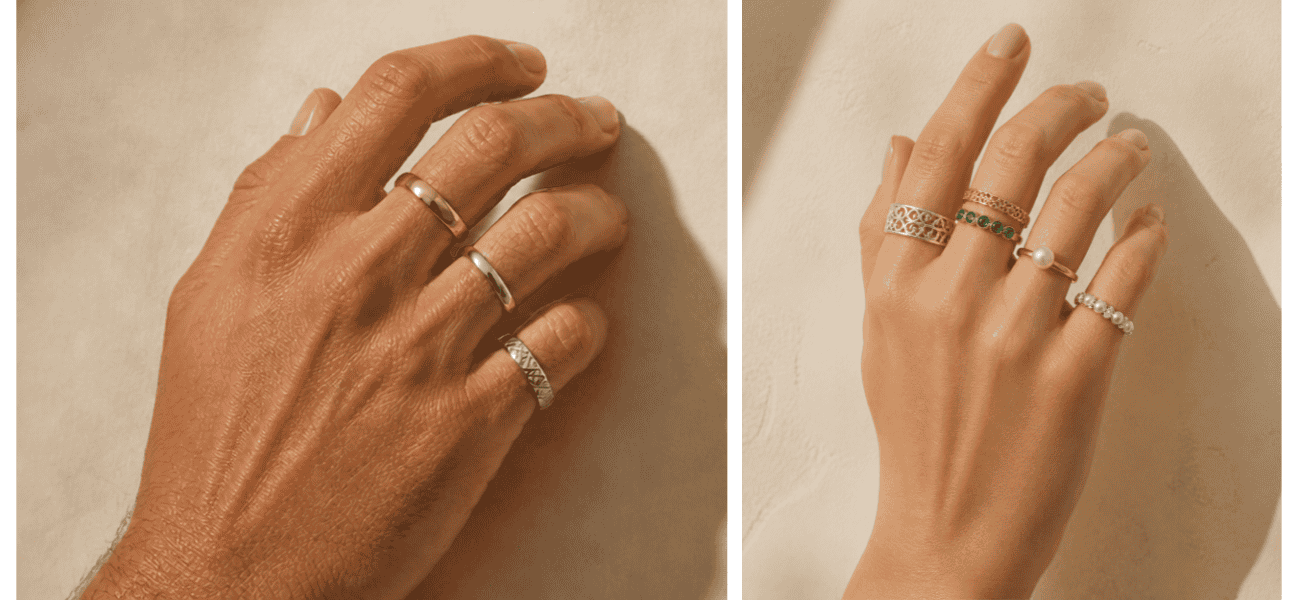
Stainless steel enters the game
If gold is the natural protagonist of this trend, there is one material that deserves its own place in this conversation: stainless steel. Long seen as a "lesser" or merely functional option, stainless steel has in recent years earned a status that no one can deny it anymore — and in the context of mixed metal, it becomes a particularly versatile ally.
The first reason is aesthetic. Stainless steel has a cool, grey, uniform tone that works as a neutral counterpoint to the warm tones of gold. Combining a steel bracelet with a yellow gold ring, or a steel necklace with layers of rose gold, creates a contrast that is neither silver nor gold — it is a third way, more contemporary and less predictable. For those who want to experiment with mixing metals without investing in a white gold piece, steel is an accessible and visually coherent gateway.
The second reason is practical. Stainless steel is durable, corrosion-resistant, and suitable for daily wear — qualities that make it especially attractive for pieces worn in layers, subject to friction and wear. Unlike gold, which requires some care, steel tolerates the pace of modern life well. In a mixed metal composition designed for everyday wear, this resistance is a real asset.
The third reason is economic and ethical. Stainless steel is significantly more affordable than gold, which allows for bolder compositions without a proportional investment. And, from a sustainability standpoint, it is a recyclable and widely available material, aligned with the circular economy logic we value. For those who want to refresh their look without buying new gold, steel offers a legitimate alternative — not as a substitute for gold, but as a complement.
There is, naturally, one care to take. Stainless steel and gold have different visual weights: steel tends to look "lighter" and cooler, while gold, even white gold, has greater visual density. In a composition, this means steel works better in larger-scale pieces or in secondary positions, letting gold take on the role of anchor. A wide steel bangle next to a delicate yellow gold ring, for example, balances better than the reverse.
It is worth noting that this coexistence between gold and steel is not an absolute novelty. Contemporary jewellery — especially that of industrial and minimalist inspiration — has been exploring this combination for several years, and autumn/winter 2026 has only consolidated it. What has changed is the legitimacy: you no longer need to justify why you wear steel next to gold. It is a choice, and an increasingly common one.
How to start: three practical approaches
For those who have never experimented with mixing gold tones, the initial temptation is to do too much. The safest approach is precisely the simplest: start with a piece that already combines different tones. A ring with two bands, a bracelet with alternating links, or a necklace whose clasp introduces a second tone are discreet ways to enter the trend without the risk of excess.
The second approach — perhaps the most democratic — is layering. Choose a base (for example, a thin yellow gold chain), add a second piece in a contrasting tone (white gold) and, if the result seems balanced, introduce a third (rose gold). The key lies in proportion: one of the tones should dominate, acting as a visual anchor, while the others come in as accents.
The third approach, more suitable for those who already feel comfortable with mixing, is asymmetrical layering. Necklaces of different lengths, in different tones, layered in a deliberately irregular way. Earrings that don't match each other. Rings stacked on different fingers. The goal is not symmetry, but personal composition — what stylists call "intention" rather than "perfection".
What distinguishes a good mix from a bad mix
Despite what the freedom of the trend might suggest, mixed metal is not random. There is a subtle but important difference between a composition that looks intentional and one that looks careless. That difference lies, above all, in consistency of style.
Mixing a minimalist white gold ring with a sculptural yellow gold bangle works because both share a design language — clean geometry, absence of excessive ornamentation. Mixing a delicate piece with a piece of a completely different style, in a contrasting tone, risks looking like a forced juxtaposition rather than a deliberate choice. The practical rule is this: the tones may vary, but the aesthetic language must maintain a line of continuity.
Another useful principle concerns physical proximity. Pieces that touch — rings on the same finger, bangles on the same wrist, layers of necklaces that overlap — benefit from a more controlled mix, with one clearly dominant tone. Pieces that occupy distinct areas of the body (earrings in one tone, a ring in another) support more pronounced contrasts without losing coherence.
Finally, there is the question of finish. The autumn/winter 2026 trend favours brushed and satin surfaces over mirrored polish. This also applies to mixed metal: a mix of tones with uniform finishes (all polished, or all brushed) reads as more cohesive than a combination that juxtaposes very different surfaces. Texture, like tone, must be thought through. And here, once again, stainless steel has an advantage: its matte or brushed finish naturally combines with brushed gold, creating a unity of texture that facilitates the mix.
Mixed metal, Portuguese style: a tradition that already existed
There is something curious about this trend when we look at it from Portugal. Traditional Portuguese goldsmithing has always had a complex relationship with metal uniformity. Filigree pieces, Viana chains, arrecadas earrings — many of these historical forms combine silver and gold, or different alloys, without any shame. The idea that metals must match each other is, to a large extent, a recent import, more linked to 20th-century industrial aesthetics than to Portuguese manual tradition.
This means that contemporary mixed metal is not a break with national tradition, but a rediscovery of a freedom that already existed. For Lusijoia, this is a particularly interesting opportunity: Portuguese gold pieces — many of them with hallmark stamps attesting to their authenticity — gain a new life when combined with each other, regardless of the tone they present. And stainless steel, due to its neutrality, can function as the bridge between pieces that would otherwise seem distant.
The trend also dialogues with the circular economy that Lusijoia has been promoting. If the used gold that reaches our hands can be reused, recycled, or transformed, mixing tones is one more argument in favour of the longevity of pieces. A yellow gold piece of jewellery that is no longer worn can become the perfect base for a layered composition with a white gold piece that was forgotten in a drawer — or with a stainless steel piece you never thought of wearing next to gold. The result is a new look with no added environmental cost.
What to avoid (without falling into dogmas)
It would be contradictory to present mixed metal as a trend of freedom and, at the same time, build a rigid list of prohibitions. But there are some common mistakes worth knowing, even if only to make them consciously.
The first is overload. Mixing three different tones in every piece worn at the same time rarely produces an elegant result. The trend works best when there is visual breathing room — when the eye finds resting points between the mixes. A look in which bracelets, necklaces, earrings, and rings all compete for attention with different tones becomes noisy instead of sophisticated. Steel, being visually more discreet, can help create those resting points — but only if it is not overused.
The second is ignoring scale. A very thin white gold ring next to a very wide yellow gold bangle can work, but the discrepancy in proportions needs to be intentional. If the smaller piece looks like an accident rather than a counterpoint, the composition loses strength.
The third — and perhaps the most important — is treating the trend as an obligation. Mixed metal is not a new rule that replaces the old one. It is a permission. Those who prefer to continue wearing only yellow gold, or only white gold, are not "out of fashion": they are making a choice as valid as any other. The difference is that, now, that choice is no longer the only possible one. And those who want to add stainless steel to that choice have, for the first time in a long time, the legitimacy to do so.
A trend with lasting consequences
What makes the autumn/winter 2026 mixed metal different from other seasonal trends is its ability to survive beyond the season. Unlike a fashion colour or a passing silhouette, mixing gold tones does not depend on a specific context. It works in summer and winter, in formal and informal contexts, with expensive pieces and with affordable pieces. And it also works with materials that are not gold — as long as the composition is thought through.
More than a trend, it is a change of mentality. For decades, jewellery was taught as an exercise in coherence: choose a style, a metal, a language, and stay faithful. What autumn/winter 2026 proposes is the opposite: that coherence is not in the uniformity of materials, but in the intention of those who wear them. A composition of different tones — yellow gold, rose gold, white gold, and even stainless steel — can be as coherent, or more so, than a perfectly monochromatic collection, as long as it reveals a conscious choice.
For those who work with used gold and second-life jewellery, this is a particularly powerful message. The pieces that reach us carry different stories, different tones, different eras. The mixed metal trend comes to say that these differences are not a defect to be corrected, but a wealth to be explored. That a heterogeneous jewellery box is not an organisation problem, but a collection of possibilities. And that stainless steel, so often forgotten, can be part of that collection.
Autumn 2026 is thus marked by a simple but transformative idea: gold does not need to be uniform to be beautiful. It can be yellow, rose, and white at the same time. It can mix with steel, layer, contradict itself. And, in the end, the result is more personal — and more modern — than any rule ever allowed.
At Lusijoia, we follow contemporary jewellery trends without forgetting the intrinsic value of each piece. If you have used gold you would like to transform — or simply evaluate — our team of certified appraisers is available to help you.
Related posts

Portuguese Justice Auctions 33 Lots of Gold Valued at Half a Million Euros

Theft with a Happy Ending: GNR recovers gold jewelry worth €80,000

A Gold Bar Hidden in Lapland: Treasure Hunt

MUDE. All the beauty of the world in 502 contemporary jewels.

Portojóia 2026: "Luxury Redefined" and the future of Portuguese jewelry

New post

Margarida Corceiro's Shine at the 2026 Venice International Film Festival

Essential Vintage Jewelry: A guide for collectors (and those who want to start)
How to Match Eyeglass Frames with Your Jewelry (The Guide Your Style Was Missing)